


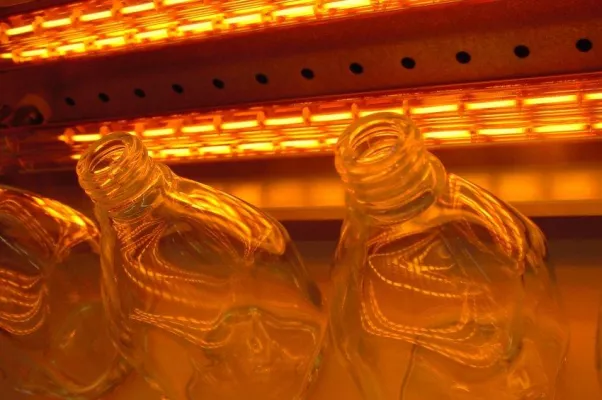
The Tug-of-War Between Sharp Prints and Strong Glass
When you try to screen-print and temper glass in one go, you’re basically fighting a war with heat. On one hand, you need the ink to set perfectly without blurring or burning. On the other, the glass itself has to get hot enough to actually temper, or the whole piece is structurally useless. It’s a tiny window of success, and if you miss it, you’ve got a mess on your hands. To handle this, we lean on short-wave infrared (IR) lamps.
Keeping the Lines Sharp
The biggest headache is “bleeding.” You know that look where the printed pattern just starts to smear? That happens when the heat ramp-up is too sluggish and the ink starts to wander. But if you just blast it with heat, you risk shocking the glass or scorching the ink. That’s why we use short-wave IR. It hits the glass fast. It gets the material up to tempering temperature quickly, which means the ink doesn’t have time to migrate. It just locks in place.
The Balancing Act
You can’t just crank the wattage to eleven and call it a day. If you use high-density IR arrays without a plan, you’ll get hotspots. To avoid that, we spend a lot of time tweaking the focal length and the angle of the reflectors. Here’s the trade-off: a tighter focus means faster curing, but it makes your margin for error much smaller. You have to find that sweet spot between the wattage per meter and how fast your conveyor is moving. If you push the lamps too hard just to save a few seconds, you’ll burn through your elements and potentially warp the glass if your cooling quench isn’t timed perfectly.
Making it Work on the Floor
Setting this up in the shop takes some real planning, especially with the wiring. We don’t just turn everything on at once. We split the heating tunnel into two zones. The first is for pre-heating—this just stabilizes the glass so it doesn’t crack from the shock. The second zone is where the real work happens, pushing the glass to its softening point. And a quick tip on the power: these high-wattage tubes pull a massive amount of current. If your electrical panel is already struggling, don’t flip all the switches at once. Stagger the lamp ignition, or you’ll be spending your afternoon resetting breakers.